

1. Introduction
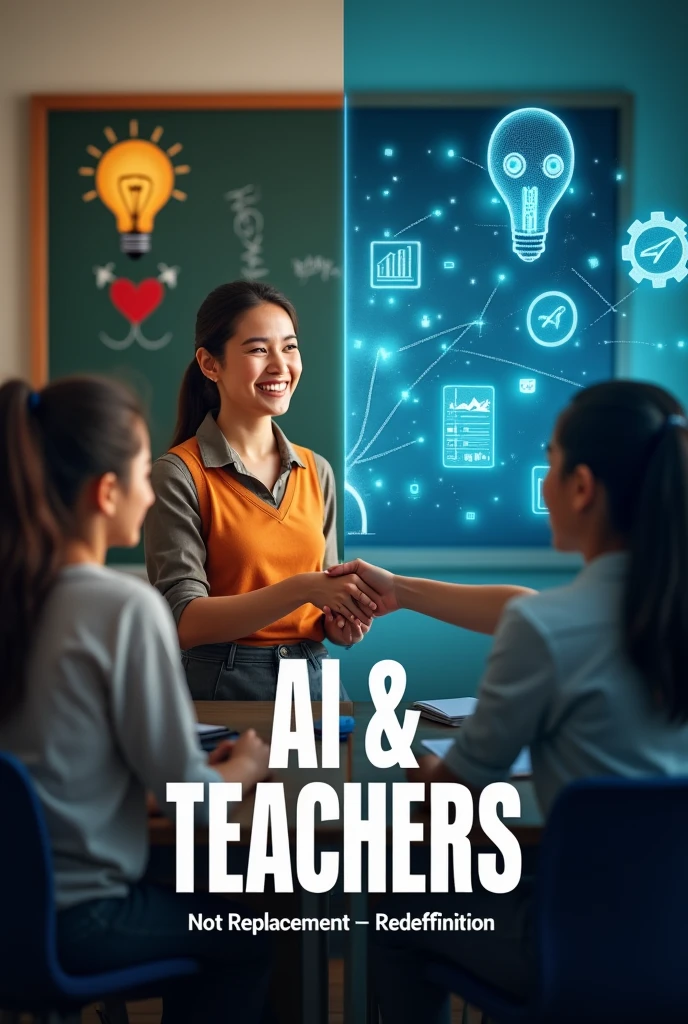
Artificial intelligence (AI) is not replacing teachers; rather, it is redefining their professional roles. By automating routine tasks such as grading, lesson planning, and administrative paperwork, AI enables educators to focus on high‑value human interactions—mentorship, critical thinking development, and emotional support (Holmes et al., 2019). At the same time, AI offers tools for personalized learning, adapting content to individual student needs. However, many teachers express concerns about students over‑relying on AI, which may erode essential skills like independent research and critical thinking. Furthermore, educators report needing more training to navigate these powerful, fast‑changing tools effectively (Trust & Whalen, 2020).
2. How AI Affects Teachers
2.1 Task Automation
AI assists with grading, providing feedback, generating teaching resources, and handling administrative burdens. This reduction in routine workload can lower the risk of teacher burnout (Zawacki‑Richter et al., 2019).
2.2 Personalized Learning
AI helps tailor lessons and work plans to individual student needs, offering targeted support. Adaptive learning platforms adjust content difficulty and pacing based on real‑time student performance, allowing teachers to address specific learning gaps more efficiently.
2.3 Enhanced Instruction
Teachers use AI for brainstorming, creating engaging activities (e.g., role‑plays, simulations), and improving writing instruction. For example, natural language processing tools can offer students immediate feedback on grammar and structure, freeing teachers to focus on higher‑order writing skills.
2.4 Professional Development
AI can act as a “GPS” for professional growth, guiding teachers to identify skill gaps and recommending personalized learning paths. This adaptive professional development is increasingly used in school districts to support continuous improvement (Trust & Whalen, 2020).
2.5 New Challenges
A notable concern, highlighted by Education Week (2021), is that students may rely too heavily on AI for assignments, potentially weakening their critical thinking, research, and problem‑solving abilities. Teachers must therefore balance AI integration with instruction on responsible use.
2.6 Evolving Role of the Teacher
The core role shifts from pure content delivery to fostering uniquely human skills—creativity, empathy, ethical reasoning, and mentorship. Human‑AI collaboration, rather than replacement, defines the future of teaching (Holmes et al., 2019).
3. Teacher Sentiment and Concerns
Teachers hold mixed feelings about AI. Many are optimistic about its potential to enhance learning and reduce workload, yet they also feel anxious about rapid technological changes and implementation challenges (ScienceDirect, 2022). According to a Pew Research Center survey (2020), secondary school teachers express more negative views regarding AI’s potential harms than elementary or middle school teachers. A common theme across studies is that schools are too slow to adapt; educators need better training, institutional support, and clear ethical guidelines to use AI effectively (Trust & Whalen, 2020).
4. How AI Is Reshaping the Teaching Process?
While AI makes personalized learning more accessible, educators must also ensure that students use AI ethically and responsibly. The following subsections detail key areas of transformation.
4.1 Assessment and Feedback
AI tools assist teachers in gathering student data and providing personalized feedback, enabling more targeted instruction. Specific capabilities include:
- Feedback support: Smart systems analyze student responses, offer immediate feedback, and streamline evaluation for various assignment types. This reduces “busy work” so teachers can focus on what matters most.
- Tracking student progress: AI makes it easier to monitor individual learning patterns and identify when students need extra support. Tools like Panorama Pathways provide actionable insights (Panorama Education, 2021).
- Personalized assessments: Experts predict AI will transform student assessments into highly personalized experiences. AI‑driven evaluations are already being tested; they adapt to each student’s learning needs, interests, and career aspirations.
4.2 Content Creation and Delivery
AI simplifies the creation of fresh learning materials, giving educators powerful ways to connect with students:
- Lesson planning: AI platforms can produce complete lesson plans tailored to learning objectives, saving hours of preparation time while aligning with curriculum standards.
- Multilingual support: Advanced translation capabilities allow teachers to instantly develop resources in multiple languages, supporting diverse and inclusive classrooms.
- Interactive learning modules: Modern AI applications transform static content into dynamic, adaptive experiences. Text‑to‑video tools turn lessons into engaging videos and generate activities tied to existing assignments.
- Differentiating content: AI makes it possible to quickly modify learning materials for various ability levels. Natural language processing can take a single lesson plan and generate multiple versions for individual students.
4.3 Student Support Systems
AI provides valuable support through platforms that offer students extra practice exercises or answer basic questions. In addition, at‑a‑glance dashboards (e.g., Student Success solutions) help teachers recognize when students need academic, behavioral, or attendance support. AI educational platforms can also create personalized learning journeys based on each student’s performance data, allowing teachers to adjust content and pacing to match individual needs.
4.4 Administrative Tasks
AI considerably reduces the time teachers spend on paperwork and planning:
- Documentation automation: When used securely, generative AI can create progress reports, learning summaries, and Individualized Education Programs (IEPs).
- Drafting communication: AI‑powered tools quickly generate email templates, announcements, and parent updates, helping teachers communicate efficiently and consistently.
4.5 Classroom Management
AI assists with tasks such as tracking attendance, analyzing student engagement during lessons, and identifying behavior patterns that may need attention or positive reinforcement:
- Monitoring engagement: AI tools monitor time‑on‑task, participation in group discussions, and other engagement metrics, providing on‑demand statistics. Early detection of disengagement helps prevent chronic absenteeism.
- Assisting with grouping: AI analyzes data to suggest optimal student groups based on academic performance and learning styles, saving teacher time and improving collaborative learning experiences.
5. Top Benefits of AI for Teachers
- Decision confidence: AI‑backed insights and data analysis enable teachers to make more confident decisions about instructional strategies, interventions, and resource allocation.
- Creativity boost: By handling routine tasks, AI frees teachers to focus on creative aspects of teaching, encouraging experimentation with innovative methods and projects.
- Collaboration enhancement: AI platforms often include communication and file‑sharing features, allowing teachers to share resources and ideas with colleagues and reducing professional isolation.
- Better work‑life balance: Traditionally, teachers stayed late or worked weekends on paperwork. AI eliminates many such tasks, helping educators reclaim their time, prevent burnout, and increase job satisfaction (Trust & Whalen, 2020).
6. Challenges of Using AI in Teaching
Despite its benefits, integrating AI into education presents several challenges:
- Data privacy and security: Protecting student data is essential. Schools must implement secure systems and clear policies.
- Algorithmic bias: AI algorithms can perpetuate or amplify existing biases. Educators and developers must anticipate and address bias to ensure fairness for all students.
- Training and ongoing support: A key challenge is ensuring that teachers and staff receive adequate training and continuous support to successfully implement AI tools in the classroom (Zawacki‑Richter et al., 2019).
7. AI in Higher Education: Transforming Teaching and Learning
Artificial intelligence is revolutionizing higher education instruction and student learning. One significant change is the rise of personalized learning platforms such as Cognii, Carnegie Learning, and other adaptive systems. These tools assess a student’s progress in real time and adjust content delivery to meet their unique needs, helping students stay engaged and supporting those who struggle with traditional methods (Holmes et al., 2019).
AI also saves faculty time by automating routine tasks. Grading software, especially for multiple‑choice or short‑answer assessments, can quickly evaluate student work, freeing instructors to focus on meaningful feedback and course design. Writing tools powered by natural language processing offer students instant feedback on grammar, coherence, and structure, allowing improvement before final submission.
Chatbots and virtual teaching assistants enhance access to support beyond the classroom. They can answer questions, explain concepts, or direct students to resources 24/7, bridging gaps in availability and reducing the burden on faculty and staff.
However, AI integration in higher education raises important concerns. Tools like ChatGPT have sparked debates around academic integrity, as students may misuse generative AI to complete assignments dishonestly. Additionally, over‑reliance on automation risks diminishing human connection and critical thinking in the learning process. Despite these challenges, when used thoughtfully, AI can be a powerful complement to traditional instruction, enabling more inclusive, responsive, and flexible learning environments—provided educators are supported in integrating it ethically and effectively (Zawacki‑Richter et al., 2019).
8. Which Jobs Are Most Vulnerable to AI?
8.1 Jobs Facing the Greatest Risk
To determine AI’s potential impact, Microsoft researchers analyzed user interactions with Bing Copilot over nine months in 2024. They narrowed conversations to those related to work tasks and measured how successfully AI completed those tasks. They then combined that data with information on which occupations include those tasks, calculating an “AI applicability score”—a measure of how likely a job is to be impacted by AI (Microsoft Research, 2024).
Roles with the highest scores tended to involve tasks such as information gathering, summarizing, or drafting—activities where AI performs well. These jobs include:
- Interpreters
- Journalists
- Political scientists
- Web developers
- Sales representatives
- Geographers
- Hostesses
- Personal financial advisors
- Economics teachers
The role with the highest applicability scores were predominantly knowledge work or white‑collar professions. The researchers found that many Copilot users employed AI for gathering information and writing tasks, at which AI rated highly.
8.2 Jobs That Are Least Vulnerable
Conversely, jobs with the lowest applicability scores involved physical labor, direct human interaction, or operating machinery. These include:
- Nursing assistants
- Ship engineers
- Embalmers
- Oral surgeons
- Massage therapists
- Maids
- Tire builders
- Roofers
- Floor sanders
These roles require manual dexterity, on‑site presence, and interpersonal empathy—areas where current AI systems have limited capability (Microsoft Research, 2024).
References
Education Week. (2021). AI in the classroom: Teachers’ concerns about student over‑reliance. Editorial Projects in Education.
Holmes, W., Bialik, M., & Fadel, C. (2019). Artificial intelligence in education: Promises and implications for teaching and learning. Center for Curriculum Redesign.
Microsoft Research. (2024). AI applicability and the future of work: Analysis of Bing Copilot interactions. Microsoft Corporation.
Panorama Education. (2021). Panorama pathways: Using data to support student success. Panorama Education.
Pew Research Center. (2020). Teacher attitudes toward artificial intelligence in K‑12 schools. Pew Research Center.
ScienceDirect. (2022). Teacher sentiment and AI implementation: A systematic review. Elsevier. [Note: If a specific article is intended, replace with full citation.]
Trust, T., & Whalen, J. (2020). Should teachers be afraid of AI? A review of the literature on artificial intelligence in K‑12 education. Computers and Education Open, 1, 100018. https://doi.org/10.1016/j.caeo.2020.100018
Zawacki‑Richter, O., Marín, V. I., Bond, M., & Gouverneur, F. (2019). Systematic review of research on artificial intelligence applications in higher education – where are the educators? International Journal of Educational Technology in Higher Education, 16(1), 39. https://doi.org/10.1186/s41239-019-0171-0
Leave a Reply