

Introduction
Education is often celebrated as the most powerful driver of human progress, yet around the world, millions of children attend school every day without truly learning. This reality exposes a fundamental truth: enrollment rates and exam scores alone cannot measure the real quality of education. A system may succeed in getting children into classrooms, but still fail to equip them with the competencies, values, and skills needed for life, work, and responsible citizenship.
According to UNESCO, quality education is one that ensures all learners acquire the knowledge, skills, values, and attitudes required to contribute meaningfully to society. It is a multi-dimensional concept that goes far beyond access to schooling—it includes the relevance of the curriculum, the competence of teachers, the learning environment, assessment systems, and the outcomes learners achieve.
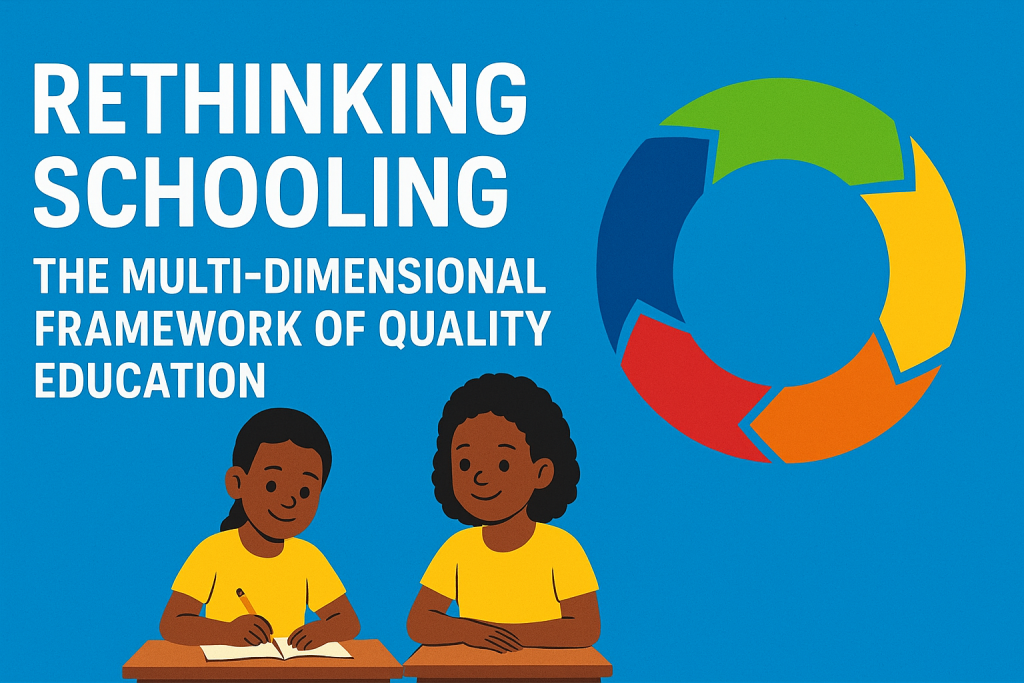
This article explores the five core dimensions of quality education that must be strengthened simultaneously to achieve genuine and sustainable educational excellence. These dimensions provide a holistic framework that guides policymakers, educators, school leaders, and communities in building education systems that truly work for all learners.
A. The Learner Dimension: Healthy and Prepared Students
The first and most fundamental dimension of quality education is the learner. Quality learning can only occur when students arrive at school healthy, motivated, and prepared to engage with the learning process. This requires addressing their physical, emotional, and psychological needs in a holistic manner.
A key component is health and nutrition, as well-nourished students are more attentive, have higher energy levels, and demonstrate improved cognitive functioning. School feeding programs, access to clean water, sanitation, and basic health services significantly enhance students’ capacity to learn.
Equally important is emotional well-being, which depends on a safe, inclusive, and non-violent learning environment where students feel respected and supported. When learners feel emotionally secure, they participate more actively and develop confidence in their abilities.
Additionally, ensuring that students possess adequate prior knowledge and foundational skills, particularly in literacy and numeracy, is essential. These early competencies enable them to build upon new concepts, progress across grade levels, and fully benefit from classroom instruction.
Together, these factors create a strong foundation for meaningful learning and long-term educational success.
B. The Content Dimension: Relevant and Rigorous Curriculum
The second dimension focuses on the content learners engage with—the knowledge, skills, values, and attitudes that form the basis of educational development. A high-quality curriculum must be relevant to students’ lives and aligned with societal needs, national development goals, and global trends.
Relevance ensures that learning is meaningful and connected to the realities students face. This includes preparing them for the demands of the modern job market and equipping them with culturally appropriate knowledge that reflects their lived experiences.
In today’s rapidly evolving world, the curriculum must emphasize 21st-century skills such as critical thinking, problem-solving, creativity, collaboration, communication, and digital literacy. These transferable skills prepare learners to navigate complex challenges and adapt to changing contexts.
Moreover, quality curriculum design requires comprehensive coverage. Education should extend beyond core academic subjects to include arts, civics, physical education, health, and environmental studies. Such breadth supports holistic development and allows students to explore diverse interests and talents.
A curriculum that is both rigorous and holistic provides the intellectual and moral foundation necessary for lifelong learning.
C. The Process Dimension: Effective Teaching and Learning
The process dimension represents the how of education—what happens in the classroom, how teachers teach, and how students interact with content and with each other. This dimension is widely regarded as one of the most critical, as it directly shapes learning experiences.
Central to this dimension is teacher quality. Effective education depends on teachers who are well-trained, motivated, and professionally supported. Strong subject knowledge, pedagogical skills, ethical conduct, and continuous development are essential for high-quality teaching.
Pedagogical approaches also play a crucial role. Modern education emphasizes student-centered and participatory methods, including collaborative learning, inquiry-based instruction, and interactive discussion. These approaches encourage deeper understanding and active engagement, moving beyond the limitations of rote memorization and passive lecturing.
Another key factor is time on task, or the effective use of instructional time. Teachers must maintain clear expectations, minimize disruptions, and ensure that classroom time is devoted to purposeful learning. Effective time management enhances continuity and improves learning outcomes.
Finally, differentiation is essential for addressing the diverse needs of learners. By adapting instruction based on students’ abilities, learning styles, and interests, teachers ensure that all students—regardless of background—can progress and succeed.
Together, these elements make the teaching–learning process dynamic, inclusive, and effective.
D. The Environment Dimension: Safe and Supportive Schools
The environment dimension concerns the where of education—the physical, social, and psychological conditions that shape learners’ experiences in school.
A foundational element is physical infrastructure. Safe, clean, and well-maintained school buildings, adequate sanitation facilities, and access to learning materials form the basic requirements for quality schooling. Water, sanitation, and hygiene (WASH) facilities, in particular, play a major role in ensuring student health and attendance, especially for girls.
Equally important is the psychosocial environment. Quality education flourishes in environments where students feel secure, respected, and included. Eliminating bullying, violence, and discrimination is essential for fostering emotional safety and a sense of belonging. Positive relationships among students, teachers, and school leaders strengthen confidence, motivation, and engagement.
Appropriate class size is another critical factor. Overcrowded classrooms hinder individualized attention and reduce the effectiveness of interactive pedagogy. Reasonable teacher-to-student ratios allow educators to provide personalized guidance, timely feedback, and differentiated support.
Collectively, these elements create a learning environment conducive to academic achievement, emotional well-being, and overall development.
E. The Results Dimension: Outcomes and Achievements
The results dimension evaluates the end product of the education system—what students know, what they can do, and how prepared they are for future challenges.
A focus on holistic outcomes is essential. Beyond academic scores, education should cultivate socio-emotional competencies, creativity, ethical values, resilience, and civic responsibility. These attributes enable learners to become productive, responsible, and compassionate citizens.
Quality education must also ensure equity of outcomes, where all students—regardless of gender, socio-economic status, location, or disability—achieve high standards. Reducing achievement gaps is a key indicator of fairness and systemic effectiveness.
Finally, the success of an education system is reflected in future readiness. Learners should graduate with the competencies necessary for higher education, employment, entrepreneurship, and active citizenship. They should possess the adaptability, problem-solving ability, and lifelong learning mindset required to thrive in a rapidly changing world.
This dimension provides a clear benchmark for assessing whether education systems are delivering meaningful and lasting results.
Conclusion
Quality education is not the result of a single intervention but the product of a balanced and coordinated effort across multiple dimensions. As demonstrated throughout this article, genuine educational excellence requires healthy and prepared learners, a relevant curriculum, effective teaching processes, supportive environments, and strong learning outcomes. Strengthening one dimension in isolation—such as improving infrastructure or introducing new textbooks—will yield limited progress if other essential elements are neglected. Each dimension interacts with and reinforces the others, creating a powerful system that determines the overall quality of education.
To transform education in a lasting and meaningful way, policymakers, educators, school leaders, and communities must adopt a holistic approach. Planning, resource allocation, and evaluation should be guided by this multi-dimensional understanding of educational quality. When all stakeholders commit to this comprehensive vision, education systems can move beyond surface-level reforms and create schools where every learner has the opportunity to thrive. Investing across all dimensions of quality education is not only an educational necessity—it is a national imperative for sustainable development and social progress.
Leave a Reply